How to Pick the Right Side of the Plane for Scenic Views on Landing [2026 Guide]
Few in-flight moments are more exasperating than paying an extra airline fee to reserve a window seat, waiting through hours of cruising altitude, and realizing during the final descent that your window frames nothing but gray fog or open water—while passengers across the aisle press their phones to the glass capturing panoramic shots of the Manhattan skyline, the Andes, or London’s River Thames. Most flyers pick seat “A” or “F” based on pure guesswork. However, securing an iconic runway approach view is not luck—it is a repeatable science dictated by runway orientation, prevailing headwinds, and standard flight arrival paths.
Commercial aircraft do not land in random directions. To maximize lift and land at safe, lower ground speeds, planes almost universally take off and land into the wind (headwinds). Because seasonal wind patterns and instrument arrival routes (STARs) are publicly tracked, you can cross-reference flight tracking databases like Flightradar24 with urban landmarks to forecast your landing view with roughly 80% to 90% accuracy. This comprehensive 2026 aviation guide breaks down the 3-step formula to identify the winning side, reveals the optimal seat choices for the world’s most scenic approaches, and highlights the wing positions and “fake window” traps you must dodge.
Scenic Airport Approaches: The Winning Window Seat Side
Compare the ideal cabin side, expected landmarks, route reliability, and approach notes across world-famous scenic destinations:
| Airport / Destination | Recommended Side | Visible Landmarks | Route Reliability | Operational Verdict |
|---|---|---|---|---|
| New York / LaGuardia (LGA) | Left Side (Seat A) | Full Manhattan skyline, Central Park, Empire State Building, and One World Trade | High (River Visual Rwy 13) | The Legendary River Visual. The jet flies down the Hudson River before banking over Central Park; Left “A” seats get an unobstructed view of Midtown. |
| London / Heathrow (LHR) | Right Side (Seat F / K) | River Thames, Tower Bridge, The Shard, London Eye, and Big Ben | High (~75% Westerly flow) | When arriving from the east over Central London on runways 27L/27R, the right side looks straight into the heart of the capital. |
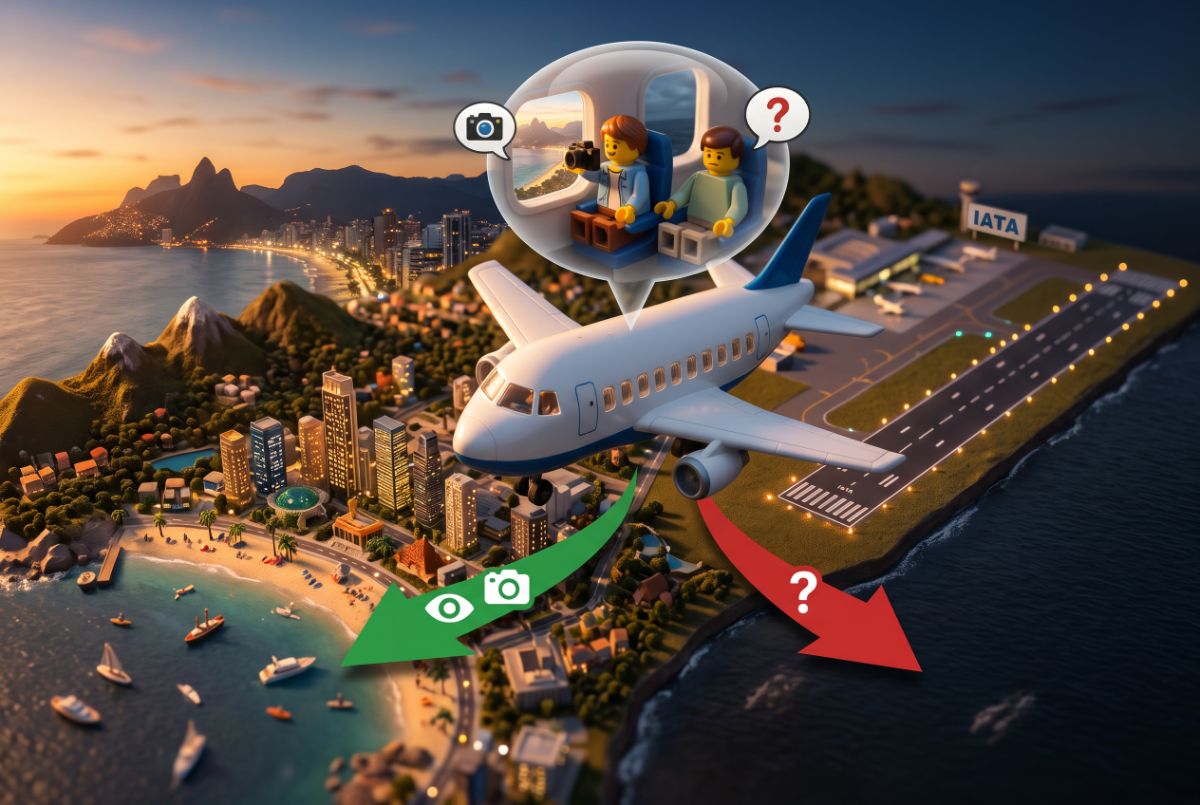
| Rio de Janeiro / Santos Dumont (SDU) | Right Side (Seat F) | Sugarloaf Mountain, Copacabana shoreline, Christ the Redeemer in the background | Very High (85% Rwy 02R) | World Aviation Classic. The aircraft executes a sharp curving approach over Guanabara Bay; Sugarloaf towers directly out the right window. |
| San Francisco (SFO) | Left Side (Seat A) | Golden Gate Bridge, Alcatraz, downtown financial district, and the Bay Bridge | Moderate to High (Runways 28L/R) | Inbound northern and eastern flights sweeping around the Bay provide left-seat passengers with views of the bridges and hills. |
| Santiago, Chile (SCL) | Left Side (Seat A) | Snow-dusted peaks of the High Andes stretching to the horizon | Very High (>90%) | Unbeatable Mountain Scenery. Flights crossing from Argentina or Brazil fly parallel to the massif; the left window sits alongside the cordillera. |
| Lisbon (LIS) | Left Side (Seat A) | Tagus River estuary, 25 de Abril suspension bridge, Belém Tower, and terra-cotta rooftops | High (Runway 02 active) | Standard descents tracking north across the river bring the historic downtown hills right past the left-side windows. |
1. Flight Mechanics: Why Approach Paths Follow Strict Patterns
Airlines do not freestyle their approaches. Knowing the mechanics behind air traffic management lets you predict the landing orientation before you check in:
- The Headwind Mandate: Airliners take off and land into oncoming air (headwind) whenever feasible. Headwinds generate greater relative airspeed across the wings at lower ground speeds, allowing aircraft to stay airborne slower, touch down softly, and stop using less runway pavement.
- Runway Compass Alignment: Runways are designated by two-digit magnetic headings rounded to the nearest 10 degrees. For instance, Runway 09/27 points east (090°) and west (270°). If regional coastal winds blow from the west, air traffic control directs planes to land on Runway 27, meaning the final approach route will point westward.
- Prevailing Regional Winds: Coastal and valley hubs feature reliable prevailing winds (such as trade winds or coastal afternoon sea breezes). Because airport surface winds lean toward one direction most days of the year, runway usage remains consistent over 75% to 85% of standard flight schedules.
2. The 3-Step Strategy to Identify the Winning Window Seat
Before confirming an assigned seat on an airline app or paying for a seat selection, run this 5-minute technical check:
- Check Flight History on Flightradar24 or FlightAware:
- Open Flightradar24 or FlightAware and search your exact flight number (e.g., DL 450, BA 115, or UA 820).
- Look at the historical playback tracks for that flight over the last 7 to 10 days at that specific arrival time. Notice the arrival pattern: Does the yellow track loop over the coastline or follow a river bank? Does it bank left or right during the final 10 minutes?
- Pinpoint Urban Landmarks on Google Maps:
- Open Google Maps and trace a straight approach line extending backward from the active runway threshold shown in your flight history.
- Locate the monuments, beaches, or mountain peaks you want to see. If the skyline sits north of the final approach track and the jet heads west, those landmarks will be visible on the right side (Seat F/K).
- Review Wind Forecasts on Windy.com:
- A few days before flying, open Windy.com or your favorite weather app and look up wind speed and direction at your destination airport.
- If winds match normal regional averages, the active runway and arrival routing from your Flightradar24 check will align with your actual flight path.
3. Avoiding the Wing Shadow: Selecting Rows for Clear Sightlines
Choosing the correct side of the cabin does not help if your window stares directly into an engine cowl or massive wing panel:
- The Wing Blind Spot: Modern jet wings (such as on an Airbus A321neo, Boeing 737 MAX, A350, or Boeing 787 Dreamliner) cover 8 to 14 rows across the middle cabin. Large turbofan engines and upturned wingtips (winglets) sit in that field of view, blocking lower diagonal sightlines toward the ground.
- How to Spot the Wing Boundary in Advance:
- Use layout platforms like AeroLOPA (which publishes architecturally accurate, to-scale cabin floorplans showing exact window, wing, and seat alignments) or SeatGuru.
- Avoid center cabin rows—typically rows 12 through 24 on standard single-aisle narrowbodies like the A320 and 737 family.
- Front vs. Rear Rows:
- Forward of the Wing (Rows 5 to 10): Offers clean views of the terrain below, lower engine noise levels, and quicker deplaning upon arrival. Many airlines categorize these as premium or extra-legroom seats.
- Aft of the Wing (Rear Third of the Cabin): Provides an excellent photographic vantage point that lets you frame the wingtip in the edge of your shot while keeping the landscape below unobstructed. Caveat: Steer clear of the final two rows by the rear galleys and lavatories, as they frequently suffer from limited recline and foot traffic.
4. Beware the “Windowless Window Seat” Trap
One of the most disappointing surprises for travelers is booking a window seat only to sit down next to a solid blank plastic fuselage wall:
- Why Missing Windows Exist: Jet airframes require vertical internal space to route critical systems, including air-conditioning riser ducts, bundles of high-voltage avionics wiring, and structural frame joints. In these specific structural sections, fuselage cutouts are eliminated.
- Infamous Windowless Rows to Avoid:
- On many Boeing 737 variants (flown by carriers like United, Southwest, Ryanair, and American), seats 9A, 11A, or 12A frequently lack a window.
- On several Airbus A320 configurations, exit rows or seats near row 12 or 14 often feature severe window misalignments where the window rests completely behind your headrest.
- How to Dodge the Trap: Cross-check your aircraft’s registration and seat plan on AeroLOPA before checking in. If the seat is marked with a missing or misaligned window symbol, switch to an adjacent row immediately.
Essential Seat Selection Street Smarts
Factor in Sun Angle to Avoid Window Glare: Even with the landmarks on your side, direct glare on acrylic window glass ruins photos. Calculate the sun’s position based on your flight’s travel direction. If you fly northbound in the early morning, the morning sun sits on the east (right side). Choosing the left side (Seat A) gives you soft, front-lit views without glare and scratches illuminated on the outer window pane.
Heading into Rio (SDU)? Always Pick the Right Side: For Santos Dumont Airport (SDU), Runway 02R handles the vast majority of operations. Aircraft fly parallel along the South Zone coastline before executing an iconic sweeping right bank over Guanabara Bay. Seat F (right window) offers an unmatched look directly at Sugarloaf Mountain rising outside the cabin as you turn onto final.
Authoritative Flight Tracking & Cabin Geometry Tools
Use established aviation reference tools to track real flight approaches, runway weather, and exact seat configurations:
- Track historical flight approach corridors and live landings on Flightradar24 (Live Global Flight Tracking).
- Audit to-scale architectural cabin layouts and window cutouts via AeroLOPA (Detailed Aircraft Seat Maps).
- Monitor aviation weather data, wind velocity, and runway surface conditions on Windy.com (Aviation Weather & Wind Forecasts).
- Explore historical air traffic data, routing patterns, and arrival corridors at FlightAware (Flight Tracking & Airport Activity).


Post Comment