Brazilian Tipping Culture: When to Tip at Restaurants, Hotels, and Airports [2026 Etiquette Guide]
Stepping off an international flight into Brazil brings an immediate wave of warm hospitality—alongside an unspoken etiquette puzzle that catches many North American and European visitors off guard: how does tipping actually work in Brazil? Travelers accustomed to North America’s mandatory 20% to 25% tipping culture often worry about offending service workers by under-tipping, or inadvertently double-tipping on restaurant checks that already include a built-in service charge (taxa de serviço).
In Brazil, aggressive tipping is not part of local culture, and service workers do not expect 20% add-ons. Instead, sit-down restaurants automatically add an optional 10% service fee (gorjeta / taxa de serviço) directly to your bill, while taxi drivers, Uber drivers, and airport skycaps operate on a completely different set of unwritten norms. This comprehensive 2026 cultural etiquette guide breaks down exactly when and how much to tip across Brazilian restaurants, hotels, airports, tour guides, and beaches—in Brazilian Reais (BRL) and US Dollars—so you navigate every transaction with confidence.
Brazilian Tipping Cheat Sheet: Restaurants, Hotels, Airports & Taxis
Compare standard local tipping norms, expected amounts in Brazilian Reais (BRL) and US Dollars, and payment customs across service categories:
| Service / Venue | Is Tipping Expected? | Standard Amount (BRL / USD) | How It Is Paid | Cultural Verdict |
|---|---|---|---|---|
| Sit-Down Restaurants & Bars | Yes (Built into bill) | 10% (occasionally 12%–13% in upscale Rio/SP spots) | Added directly to card machine total (“Posso incluir os 10%?”) | Do Not Double-Tip. Leaving an extra 15%–20% on top of the 10% line item is unnecessary. |
| Cafés, Counter Service & Street Food | No | R$ 0 (optional spare change in tip jar) | No tip prompt on payment terminals | Brazilians pay the exact menu price at bakeries (padarias), juice bars, and kiosks. |
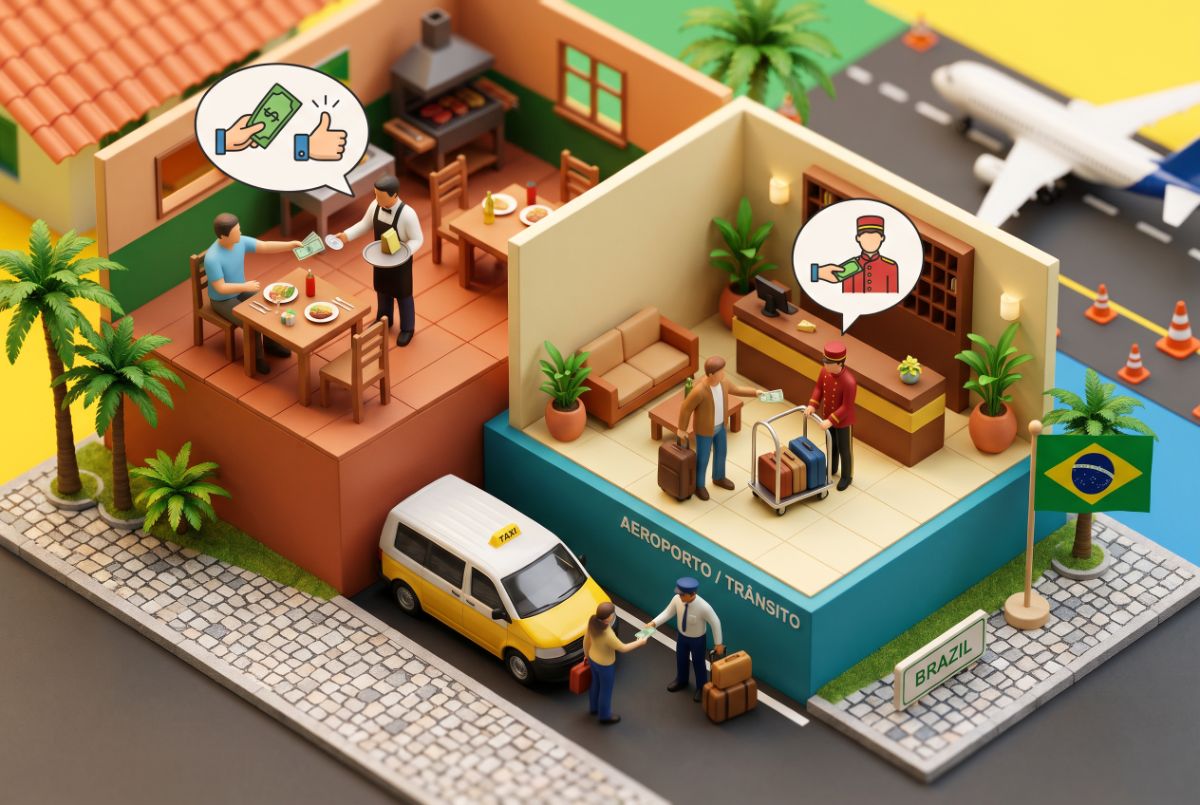
| Hotel Bellhops & Valets | Appreciated / Customary | R$ 5 to R$ 10 per bag (~$1 – $2 USD) | Cash banknotes only (BRL) | Keep R$ 10 and R$ 20 bills handy at check-in; card terminals are not used for bellhop tips. |
| Hotel Housekeeping | Optional (Nice gesture on multi-night stays) | R$ 10 to R$ 20 per day (~$2 – $4 USD) | Cash left on pillow/desk with a brief note (“Obrigado”) | Leave daily rather than at checkout so the specific housekeeper who cleaned your room receives it. |
| Airports (Porters & Lounge Staff) | Only if using a luggage porter (carregador) | R$ 10 to R$ 20 total (~$2 – $4 USD) for trolley help | Cash banknotes (BRL) | Most travelers push their own free luggage carts; no tipping expected at airport cafes or lounges. |
| Taxis, Uber & Private Transfers | No (Round up fare at most) | Round up to nearest R$ 5 (or R$ 20–50 for full-day private drivers) | In-app tip (Uber/99) or cash | Metered taxi drivers do not expect tips; simply say “Pode ficar com o troco” (keep the change). |
| Tour Guides & Boat Crew | Yes (For good service) | R$ 20 to R$ 50 per person (~$4 – $9 USD) | Cash banknotes (BRL) at end of tour | Standard for full-day buggy rides, boat charters, and private walking tours. |
1. Restaurants & Bars: Understanding the 10% “Taxa de Serviço”
In Brazil, tipping at restaurants is streamlined and transparent—there are no awkward tip-screen prompts asking you to choose between 18%, 22%, and 25%:
- The Standard 10% Service Charge (Gorjeta): Almost every sit-down restaurant, steakhouse (churrascaria), and beach bar automatically adds a 10% service line item to your itemized check (conta). In high-end dining rooms in São Paulo and Rio de Janeiro, this optional line occasionally reaches 12% or 13%.
- Legally Optional, Culturally Standard: Under Brazilian federal law (Lei da Gorjeta), the 10% service charge is legally optional—servers will routinely ask politely, “Posso incluir os 10%?” (“May I include the 10%?”) before running your credit card. Unless service was genuinely terrible, Brazilians always accept the 10% charge.
- Watch Out for “Couvert Artístico” (Live Music Cover Charge): If a restaurant or bar features live samba, MPB, or bossa nova musicians, you will see a separate fixed charge on your bill labeled Couvert Artístico (typically R$ 10 to R$ 30 per person). By Brazilian consumer protection law, venues must clearly notify patrons at the entrance or on the menu before charging a music cover fee.
- Bread & Appetizer Trays (“Couvert de Mesa”): At upscale restaurants, waiters may place bread, olives, and spreads on your table before you order. Unlike in the US, this starter basket is not free unless stated—if you do not touch it, you will not be charged, or you can politely decline it immediately.
2. Hotels & Resorts: Cash Only for Bellhops & Housekeeping
While Brazil is an overwhelmingly cashless society where even street coconut vendors accept contactless Apple Pay and Google Pay, hotel tipping remains strictly cash-based:
- Bellhops & Luggage Porters: Tipping R$ 5 to R$ 10 per bag (or R$ 10 to R$ 20 total for a family luggage trolley) when a bellhop carries your suitcases to your room is customary at 4- and 5-star hotels and beach resorts.
- Housekeeping Staff: Leaving R$ 10 to R$ 20 per day on the nightstand or desk is deeply appreciated, especially at beach resorts where cleaners deal with heavy sand daily. Leave cash daily rather than in one lump sum at checkout so the specific staff member cleaning your room receives it.
- Valet Parking Attendants: If your hotel or restaurant offers paid valet parking (manobrista), the valet fee already covers the service; tipping an extra R$ 5 in cash upon vehicle retrieval is optional.
3. Airports, Taxis, Uber & Private Transfers
Ground transit and airport terminals follow minimal tipping expectations:
- Airport Luggage Porters (Carregadores): At major international hubs like São Paulo (GRU) and Rio de Janeiro (GIG), official uniformed luggage porters operate near international baggage claim carousels. If you hire one to load and push a heavy cart through customs to your transfer vehicle, tip R$ 10 to R$ 20 in cash.
- Metered Taxis & Airport Fixed-Rate Cabs: Taxi drivers in Brazil do not expect a percentage tip. Rounding up a R$ 47 meter fare to R$ 50 by saying “Pode ficar com o troco” (“You can keep the change”) is polite and sufficient.
- Uber & 99 Rideshare Drivers: You can add an optional R$ 3 to R$ 10 tip inside the app after your ride concludes—especially appreciated if a driver helps load heavy airport suitcases or navigates gridlocked holiday traffic smoothly.
- Private Airport Transfers & Full-Day Drivers: For a straightforward 45-minute airport-to-hotel transfer, tipping is not required, though handing R$ 10 to R$ 20 for exceptional luggage assistance is welcomed. If you hire a dedicated private driver for a full-day excursion, tip R$ 30 to R$ 50 at the end of the day.
4. Beach Kiosks, Gas Stations & Tour Guides
A few everyday Brazilian service situations confuse foreign visitors:
- Beach Chairs & Umbrellas (Barracas de Praia): On beaches like Ipanema, Copacabana, or Porto de Galinhas, vendors set up chairs and umbrellas and serve drinks and snacks on the sand. When you ask for the bill at the end of the afternoon, they will include the standard 10% service charge on your food and drink tab—no extra cash tip is needed.
- Full-Service Gas Stations (Frentistas): Self-service gas pumps are illegal in Brazil—attendants pump your fuel, clean your windshield, and check tire pressure automatically. Do not tip gas station attendants; this is standard salaried service across the country.
- Tour Guides, Buggy Drivers & Boat Crews: On guided group excursions, buggy tours in the Northeast dunes, or schooner boat trips, tipping R$ 20 to R$ 50 per person in cash to your guide or boat crew at the end of the day is standard practice when you enjoyed the experience.
Essential Brazilian Tipping & Cash Street Smarts
Never Tip in US Dollars or Euros: Unlike tourist zones in Mexico or the Caribbean where US dollars circulate freely, foreign banknotes are useless to Brazilian hotel staff, waiters, and drivers. Banks and exchange bureaus in Brazil charge steep fees and impose strict documentation rules to convert small foreign bills. Always withdraw Brazilian Reais (BRL) at an airport bank ATM upon arrival and break large R$ 100 notes at airport cafés so you carry small R$ 5, R$ 10, and R$ 20 bills for tips.
Always Check the Receipt Before Tapping Your Card: Even at honest restaurants, server errors happen. Before tapping your contactless credit card or Apple Pay on the waiter’s handheld terminal, glance at the printed bill to verify that the 10% service fee was calculated accurately and that no duplicate items were entered—and remember you never need to ask the waiter to manually add another 15% on top.
Authoritative Brazilian Consumer & Tourism Portals
Verify consumer pricing laws, mandatory service fee disclosure rules, and official travel advisories through Brazilian government portals:
- Review Brazilian consumer protection rules regarding optional service charges and cover fees via Fundação PROCON-SP (Consumer Protection Guidelines).
- Explore official regional travel etiquette, cultural tips, and destination guides via Visit Brasil (EMBRATUR – Brazilian Tourist Board).
- Check official currency exchange information and banknote denominations on the Central Bank of Brazil (Banco Central do Brasil).
- Review official city visitor guides and consumer tips for Rio de Janeiro via Visit Rio (Official Rio de Janeiro Tourism Portal).

Post Comment