How to Measure Carry-On Luggage at Home to Avoid Gate Fees [2026 Airline Size Guide]
You booked a budget-friendly basic economy fare without checked bags, packed everything neatly into a compact rolling suitcase, and strolled up to your boarding gate. Suddenly, a gate agent points toward the dreaded metal bag sizer cage beside the podium and asks you to drop your suitcase inside. You push down, and the spinner wheels catch on the steel rim—or an overstuffed front pocket bulges out by a mere half-inch. The financial hit is immediate: mandatory gate-checking with on-the-spot penalty fees ranging from $65 to $100 USD on US carriers, or €45 to €75 on European airlines.
The mistake that trips up thousands of travelers happens at home before leaving for the airport: measuring only the main fabric or hard-shell body of the suitcase while ignoring spinner wheels, top grab handles, side feet, and bulging exterior pockets. Under global aviation rules, maximum carry-on dimensions apply to the absolute outermost points of the bag when fully packed. This practical 2026 aviation guide teaches you how to measure both your carry-on suitcase and personal item with millimeter accuracy at home, compares exact size and weight limits across major US and European carriers, and shares proven hacks to pass gate inspections effortlessly.
Carry-On & Personal Item Size Limits by Major Airline
Compare maximum dimensions (Height x Width x Depth, including wheels and handles) and cabin weight limits across top global airlines:
| Airline | Carry-On Bag (Max Dimensions) | Cabin Weight Limit | Personal Item (Under Seat) | Gate Enforcement Strictness |
|---|---|---|---|---|
| Delta / United / American Airlines | 22 x 14 x 9 in (56 x 35 x 23 cm) | No strict weight cap (must lift into bin unassisted) | 18 x 14 x 8 in (45 x 35 x 20 cm) | Moderate on size; United Basic Economy prohibits overhead carry-on bags entirely on domestic/Americas routes. |
| British Airways / Air France / KLM | 56 x 45 x 25 cm (BA) / 55 x 35 x 25 cm (AF/KLM) | 23 kg / 51 lbs (BA) / 12 kg / 26 lbs (AF/KLM) | 40 x 30 x 15 cm (16 x 12 x 6 in) | Moderate to High; Air France/KLM enforce combined 12 kg weight checks strictly at European hubs. |
| Lufthansa / Swiss / TAP Air Portugal | 55 x 40 x 23 cm (LH) / 55 x 40 x 20 cm (TAP) | 8 kg / 17.6 lbs (LH/Swiss) / 10 kg / 22 lbs (TAP) | 40 x 30 x 10–15 cm | Very Strict. Gate and security entrance scales are routinely used to weigh roller bags. |
| Ryanair / Wizz Air / easyJet (Base Fare) | NOT included in base fare (Requires Priority/Large Bag upgrade: 55 x 40 x 20–25 cm) | 10 kg / 22 lbs (with paid upgrade) | 40 x 20 x 25 cm (Ryanair) / 40 x 30 x 20 cm (Wizz) | Extreme Enforcement. Gate staff rigorously size bags; oversized items incur €45 to €75 gate fines immediately. |
| Spirit / Frontier Airlines (Base Fare) | NOT included in base fare (Paid add-on: 22 x 18 x 10 in) | 40 lbs / 18 kg (paid carry-on) | 18 x 14 x 8 in (45 x 35 x 20 cm) | Extreme Enforcement. Every bag is visually checked against metal sizers before boarding; $79–$99 gate penalty. |
1. The Exact Method to Measure Your Suitcase at Home
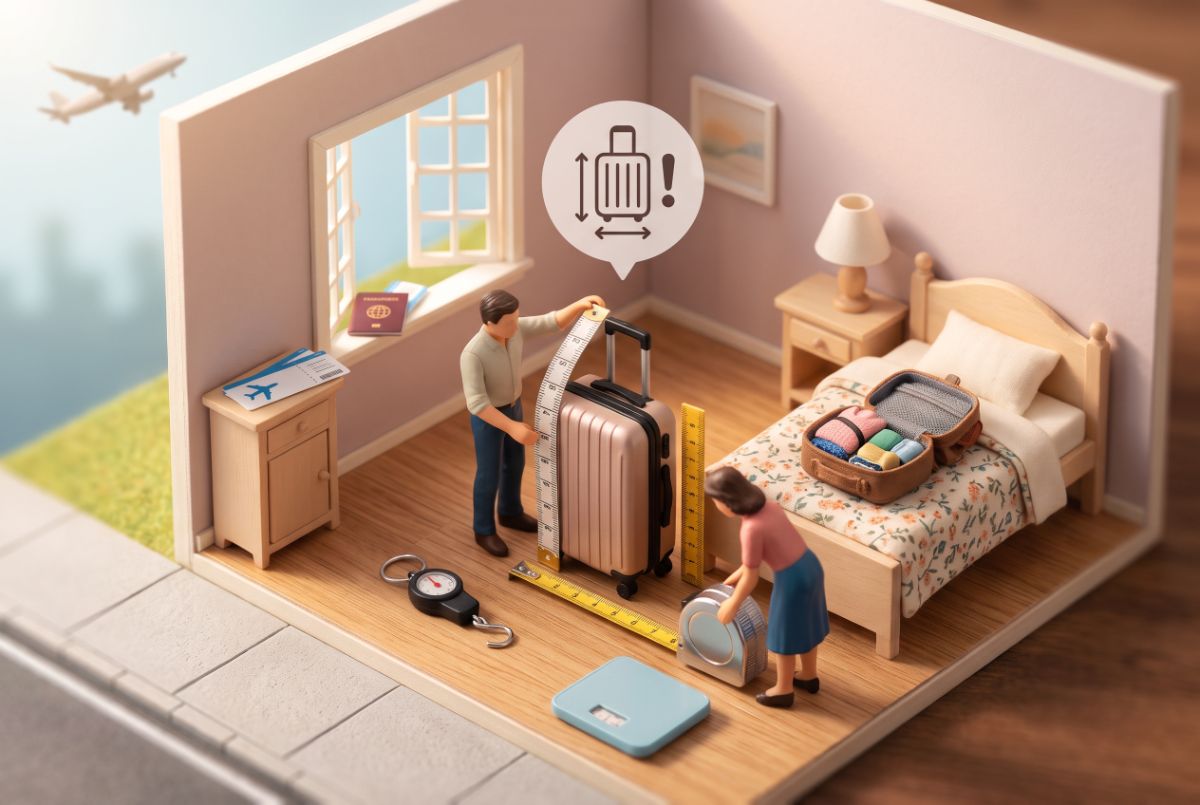
To accurately replicate an airport metal sizer cage in your living room, follow this four-step measurement protocol with your bag completely packed and zipped shut:
- Always Measure After Packing (Never Empty): Soft-sided nylon suitcases and even flexible polycarbonate hard-shells bow outward once stuffed. A front exterior pocket packed with chargers, jackets, or books can easily push depth from 8.5 inches (21.5 cm) to over 10.5 inches (26.5 cm).
- Use the Wall-and-Book Method for Height (Vertical Axis):
- Stand your packed suitcase upright on a hard, flat floor with its back pressed flush against a blank wall.
- Ensure the retractable telescoping handle is pushed all the way down, then rest a hardcover book or flat clipboard horizontally across the highest point of the top carry handle.
- Mark that line lightly on the wall and measure from the floor up: this captures the true total height including spinner wheels and top handles. If it exceeds 22 inches (55–56 cm), it risks failing metal sizers.
- Measure Width and Depth at the Widest Protrusions:
- Width (Side-to-Side Axis): Measure edge to edge including side grab handles, plastic side stud feet, and zipper pulls (standard limit: 14 inches / 35 cm in North America; up to 40 cm on many European airlines).
- Depth / Thickness (Front-to-Back Axis): Measure from the rear shell to the furthest bulging point of the front lid or exterior pocket (standard US limit: 9 inches / 23 cm; watch out for strict 20 cm / 7.8 inch limits on TAP Air Portugal, Ryanair, and Iberia).
- Keep the Expansion Zipper Closed: Most modern 21-inch carry-ons feature a secondary expansion zipper that adds 1.5 to 2 inches (4 to 5 cm) of packing depth. While great for road trips, unzipping the expander almost always pushes your suitcase past the 9-inch (23 cm) cabin depth limit.
2. How to Weigh Your Carry-On Without a Luggage Scale
While major US domestic airlines rarely weigh carry-on bags, European, Asian, and Middle Eastern airlines strictly enforce cabin limits ranging from 7 kg (15.4 lbs) to 10 kg (22 lbs):
- The Bathroom Scale Subtraction Trick: If you don’t own a handheld digital hook scale, step onto your standard bathroom scale empty-handed and note your weight. Step back onto the scale holding your packed suitcase and subtract the difference.
- Watch Your Empty Suitcase Weight: Budget hard-shell roller bags with heavy frames can weigh 7.5 to 8.5 lbs (3.4 to 3.8 kg) completely empty—eating up nearly half your allowance on an 8 kg Lufthansa or Emirates flight. Look for lightweight polycarbonate or soft-sided spinners weighing under 5.5 lbs (2.5 kg) empty.
3. Overhead Carry-On vs. Personal Item: Understanding the Difference
Unless you purchased a restrictive basic economy fare on an ultra-low-cost airline, your ticket includes two distinct cabin items:
- 1 Overhead Bin Carry-On Bag: A rolling suitcase or weekender duffel up to 22 x 14 x 9 inches (55 x 35 x 23 cm).
- 1 Under-Seat Personal Item: A laptop backpack, tote bag, purse, or camera bag.
- The Under-Seat Footprint Test: Your personal item must slide completely underneath the seat in front of you without protruding into foot space or blocking aisle evacuation paths.
- Ultra-Low-Cost & Basic Economy Warning: Base fares on Ryanair, Wizz Air, easyJet, Spirit, Frontier, and United Basic Economy (on domestic/short-haul Americas flights) include ONLY one small personal item (e.g., 40 x 20 x 25 cm on Ryanair or 18 x 14 x 8 in on Spirit/Frontier). Bringing a rolling suitcase to the gate without paying for a carry-on upgrade triggers immediate punitive gate fees.
4. What to Do If Your Bag Exceeds Limits by 1 or 2 Centimeters
If your at-home measurement shows your bag sits right on the edge of airline restrictions:
- Use External Compression Straps (Soft-Sided Bags): Wrapping two adjustable nylon luggage straps around a soft-sided suitcase or travel backpack compresses front-to-back bulging by up to 1.2 inches (3 cm), allowing the bag to slide smoothly into rigid metal sizer frames.
- Shift Heavy Dense Items Into Your Personal Item or Jacket Pockets: Laptops, power banks, books, and heavy toiletries belong in your under-seat backpack if your roller bag nears the 8 kg or 10 kg weight cap. Wear your heaviest coat or boots onto the plane—clothing worn on your body never counts toward baggage limits.
- Take Advantage of Free Gate-Check Offers: On full flights, gate agents frequently announce complimentary gate-checking for standard carry-on bags due to limited overhead bin space. If your suitcase meets size limits and you don’t mind checking it for free, volunteer at the podium (just remember to remove laptops, spare lithium batteries, prescription medications, and passports first).
Essential Carry-On Measurement Street Smarts
Watch Out for Regional Commuter Jets (CRJ & Embraer E175): Even when your rolling suitcase strictly measures 22 x 14 x 9 inches, regional turboprops and small commuter jets (like Bombardier CRJ-200/700 or Embraer ERJ-145 aircraft) feature compact overhead bins that cannot accommodate standard hard-shell rollers. On these flights, crews operate valet gate-checking (green/pink tags): you leave your bag on the jet bridge cart just before boarding and pick it up right outside the aircraft door upon landing at zero charge.
Never Wait Until the Airport Counter to Buy Baggage: If your at-home tape measure proves your bag exceeds cabin limits, purchase a checked bag or Priority carry-on upgrade online via the airline’s app at least 3 to 6 hours before departure. Pre-paying online typically costs 40% to 60% less than paying at airport check-in desks or facing maximum penalty fees at the boarding gate.
Authoritative Airline Baggage Rules & Aviation Guidelines
Verify updated cabin size charts, weight restrictions, and prohibited item lists through official aviation portals:
- Review global cabin baggage dimension standards on the International Air Transport Association (IATA Baggage Guidelines).
- Check official US carry-on size and personal item requirements on Delta Air Lines (Carry-On Baggage Rules).
- Verify strict European personal item sizer dimensions via Ryanair Official Bag Rules.
- Review carry-on security screening rules for liquids and electronics on the Transportation Security Administration (TSA Carry-On Rules).

Post Comment