Secondary Airports: When a Cheap Flight Ends Up Costing You More [2026 Guide]
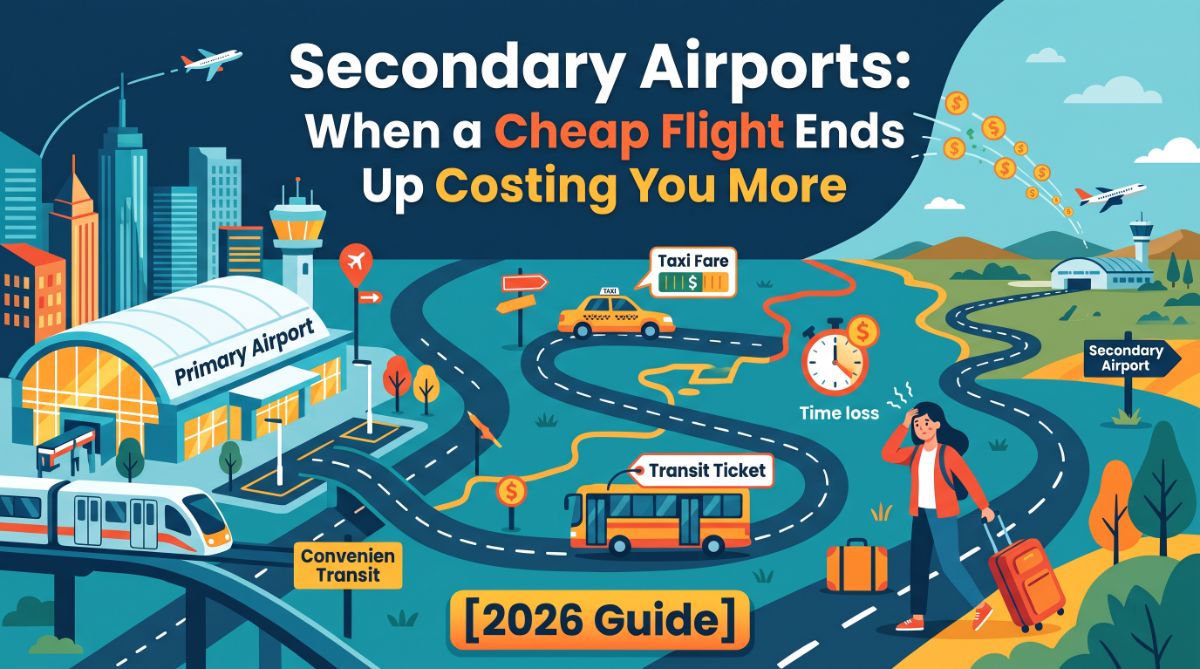
Browsing flight aggregators like Google Flights or Skyscanner often delivers an adrenaline rush when you spot an unbelievable bargain. A one-way ticket to “Paris” for €25, a flight to “London” for £19, or a cross-country hop for a fraction of the standard legacy fare feels like a major travel victory. But for thousands of unsuspecting travelers each week, that euphoria turns into frustration upon arrival: the flight does not touch down anywhere near the historic capital, but at a remote secondary or tertiary airfield situated 50 to 80 miles (80 to 130 km) away from the actual destination.
Ultra-low-cost carriers (ULCCs) like Ryanair, Wizz Air, Frontier, and Allegiant maintain razor-thin base fares largely by operating out of secondary regional hubs that charge minimal aircraft landing and parking fees. However, what looks like an upfront budget win often unravels into a financial loss once you calculate the final trip balance. Expensive dedicated coach tickets, airport express trains, forced overnight hotel stays, and three-figure taxi fares for early morning departures quickly swallow any original savings. This comprehensive 2026 travel analysis dissects the hidden economics of alternative airports, compares the world’s most notorious secondary hubs, and teaches you how to calculate the true door-to-door cost before you book.
Primary vs. Secondary Airports: Ground Transit Costs & Travel Time Compared
Compare the world’s most common secondary hubs against their primary counterparts to see how ground transit impacts your wallet:
| Intended Destination | Primary Hub (Central) | Secondary / Budget Airport | Distance to City Center | Round-Trip Ground Transit Cost (Per Person) | One-Way Travel Time to Downtown |
|---|---|---|---|---|---|
| Paris (France) | Charles de Gaulle (CDG) / Orly (ORY) | Beauvais–Tillé (BVA) | ~53 miles (85 km) | €34 – €40 (~$37 – $44 USD) | 1h 15m to 1h 45m (coach shuttle to Porte Maillot) |
| London (United Kingdom) | Heathrow (LHR) / Gatwick (LGW) | Stansted (STN) / Luton (LTN) | ~35 to 40 miles (55–65 km) | £25 – £45 (~$32 – $58 USD) | 50m to 1h 20m (express train or National Express coach) |
| Frankfurt (Germany) | Frankfurt am Main (FRA) | Frankfurt–Hahn (HHN) | ~78 miles (125 km) | €38 – €45 (~$41 – $49 USD) | 1h 45m to 2h 15m (Flibco bus to Frankfurt Hbf) |
| Milan (Italy) | Linate (LIN) / Malpensa (MXP) | Bergamo Orio al Serio (BGY) | ~31 miles (50 km) | €12 – €20 (~$13 – $22 USD) | 50m to 1h 15m (shuttle coach to Milano Centrale) |
| New York City (USA) | JFK / LaGuardia (LGA) / Newark (EWR) | New York Stewart (SWF) | ~65 miles (105 km) | $48 – $55 USD | 1h 30m to 2h 00m (Megabus to Midtown Manhattan) |
1. True Cost Calculation: The Illusory €20 Airfare
Smart travel budgeting requires computing the Total Door-to-Door Journey Cost (TDJC) instead of merely evaluating the base fare displayed on flight search engines:
- The Classic Paris-Beauvais Case Study: Imagine you find a flight from Rome to Paris-Beauvais (BVA) for €25 ($27 USD) on a budget carrier, while an Air France flight directly into Paris Charles de Gaulle (CDG) costs €65 ($71 USD). The upfront saving appears to be €40. But look at the total ledger:
- The official Beauvais shuttle coach to Porte Maillot in western Paris costs €17 each way (€34 round-trip);
- From Porte Maillot, you still need a local Paris Métro ticket (€2.15) to reach your hotel, adding roughly €4.30 round-trip;
- The bus journey takes 1 hour and 20 minutes each way under clear conditions, stretching past two hours during weekday rush hours.
- In contrast, taking the RER B commuter train from Charles de Gaulle directly into central Paris costs €11.80 and takes just 35 minutes.
The Bottom Line: Your “budget” trip via Beauvais totaled €63.30, while the primary airport option was €88.60. You saved barely €25 in exchange for nearly three hours of grueling highway travel, bus queues, and luggage-hauling through crowded transit depots. If traveling with a companion or family, those shuttle costs multiply exponentially.
2. The Four Hidden Traps of Remote Regional Airports
Beyond predictable train or bus tickets, alternative airports conceal several indirect financial pitfalls that can blow your travel budget:
- 1. The 06:00 AM Departure Trap (The Taxi Nightmare): Budget airlines frequently schedule departures between 06:00 and 06:45 AM to maximize daily aircraft rotations. To clear security two hours prior, you must arrive at the airport by 04:00 AM. In many secondary hubs, regional trains and express buses do not operate between midnight and 04:30 AM. If public transport is offline, your only option is a pre-booked taxi or private airport transfer across 50 to 80 miles—a single ride that regularly tops €130 to €200 ($140 to $220 USD), completely obliterating your budget.
- 2. Burning Valuable Vacation Time: On a short 3- or 4-day city break, your time is your most valuable asset. Spending four hours round-trip sitting on a highway bus burns half a day of sightseeing, dining, and museum visits just to save the cost of a modest dinner.
- 3. The Add-On Fee Avalanche: Ultra-low-cost carriers operating from tertiary airports strip everything from the base ticket price. That £20 fare covers only a small personal backpack under the seat. Adding a 10 kg overhead cabin bag (£20–£35 each way) or a checked bag (£30–£55 each way), plus seat selection, often brings the final ticket price higher than a legacy airline flying into the central hub with luggage and seat assignment included.
- 4. Shuttered Terminals and Sparse Amenities: Unlike major international hubs that operate 24/7 with endless dining choices, airline lounges, and pharmacies, secondary airfields often feature spartan facilities with inflated captive-audience prices. Some secondary terminals (like Beauvais) literally lock their doors overnight, meaning passengers cannot sleep inside the terminal between late flights.
3. When Does Flying to a Secondary Airport Actually Make Sense?
Despite the extra logistical hurdles, choosing a secondary or regional airport can be a brilliant operational move under specific conditions:
- Your Real Destination Lies in the Region, Not the Capital: If you are planning to explore the Italian Lakes (Lake Como, Lake Garda) or the southern Alps, landing at Milan Bergamo (BGY) places you significantly closer to your actual itinerary than landing at Milan Malpensa or Linate. Similarly, landing at Girona (GRO) instead of Barcelona El Prat (BCN) drops you directly into Catalonia’s picturesque Costa Brava.
- Renting a Car for an Open-Road Road Trip: If you plan to rent a car immediately upon arrival, secondary airports are often superior. Rental car desks are smaller with shorter queues, daily vehicle rental rates and airport concession fees are substantially lower, and you can drive straight onto rural highways without navigating dense metropolitan traffic jams.
- Subsidized or Free Airline Shuttles: On certain competitive routes, airlines or local airport authorities offer heavily discounted or complimentary express shuttles to bridge the distance. When reliable, comfortable ground transit is free or negligible in cost, the fare savings on your ticket translate directly into pure profit.
4. The Pre-Booking Reality Checklist
Before entering your credit card details on a suspiciously cheap flight, run through these three verification steps:
- Check the Three-Letter IATA Airport Code: Never rely on the city name typed into the search bar. Look for the exact airport code (e.g., BVA instead of CDG/ORY; HHN instead of FRA; STN/LTN instead of LHR/LGW; SWF instead of JFK/EWR).
- Verify Real-World Ground Shuttle Timetables: Visit the official website of the secondary airport before booking your flight. Check the exact bus and train schedules corresponding to your specific arrival and departure times—paying critical attention to weekend schedules, late-night arrivals (after 22:30), and early morning departures (before 07:00).
- Calculate the Combined Total: Add: [Round-trip Airfare] + [Cabin/Checked Baggage Fees] + [Round-trip Ground Transit Per Person]. Compare that final figure to a flight landing at the main hub. If the difference is under 15% to 20%, the convenience, speed, and peace of mind of the central airport almost always wins.
Essential Secondary Airport Street Smarts
Book Express Shuttles Online in Advance: For popular budget corridors—such as the Beauvais-Paris shuttle, Stansted Express in London, or Flibco buses connecting Hahn and Charleroi—purchasing your transit tickets online beforehand yields discounts of 20% to 35% compared to walk-up station ticket desks, while securing your seat on high-demand departure banks.
Beware of Deceptive Airline Airport Naming: Low-cost airlines famously append major metropolitan names to distant rural towns. “Frankfurt-Hahn” sits 78 miles (125 km) from Frankfurt; “Stockholm-Västerås” sits 65 miles (105 km) from Stockholm; and “Paris-Vatry” is a staggering 93 miles (150 km) from the Eiffel Tower. Always drop a pin on Google Maps to verify the actual driving distance before booking.
Authoritative Transit Portals & Journey Planners
Verify ground transfer timetables, regional train fares, and airport logistics directly via official transport authorities:
- Check official shuttle bus schedules and fares at Aéroport Paris Beauvais Official Transit Guide.
- Explore London rail and coach options across all regional hubs via Transport for London (TfL Official Portal).
- Review intercity coach connections across European regional airports at Flibco Airport Shuttle Network.


Post Comment