Connecting Flights in Europe: How Schengen vs. Non-Schengen Layovers Work [2026 Guide]
Booking a long-haul flight to Europe almost inevitably involves a connection at a major continental aviation hub. Whether you are flying to Rome via Frankfurt, Athens via Paris, or Florence via Amsterdam, your journey will likely require deplaning and navigating a bustling European transit facility. Yet it is precisely during that first layover that thousands of international passengers run into an unexpected bottleneck: instead of strolling directly to their onward departure gate, they are channeled into an extensive passport control line or routed through an additional security screening checkpoint.
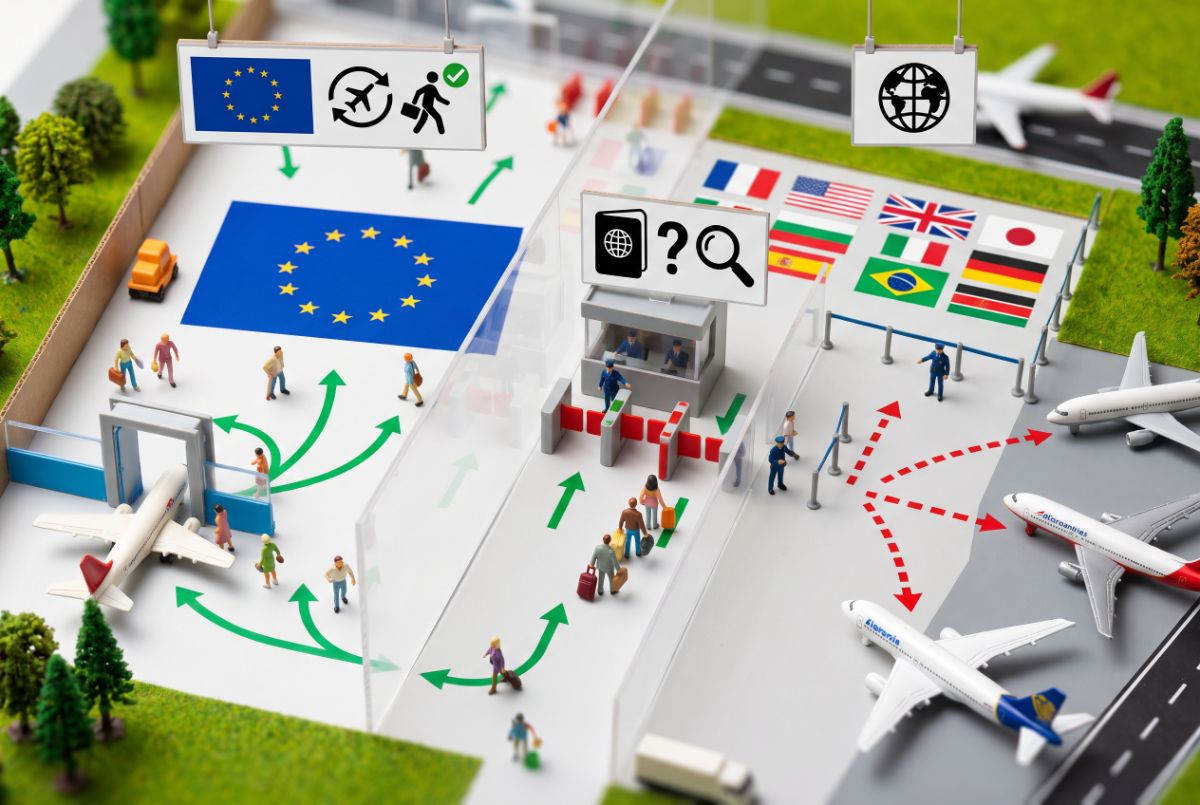
This operational surprise happens because many travelers conflate the European Union (a political and economic union) with the Schengen Area (a border-free travel zone comprising 29 European countries). Understanding in which city you clear immigration, where customs inspects your checked bags, and whether your second flight leg operates as an international or domestic flight is critical to surviving tight 50- or 60-minute connections. This comprehensive 2026 aviation guide breaks down Schengen vs. Non-Schengen flight mechanics, clarifies customs versus immigration rules, and ensures you make your European connections without stress.
European Layover Mechanics: Schengen vs. Non-Schengen Compared
Compare passport control locations, checked baggage handling, and minimum connection times across standard flight scenarios:
| Itinerary Profile | Where Do You Clear Passport Control? | Where Do Checked Bags Clear Customs? | Nature of the 2nd Flight Leg | Minimum Safe Layover Window |
|---|---|---|---|---|
| Entering Schengen via Hub (e.g., JFK > FRA > FCO) | At the 1st European landing airport (Frankfurt) | At the final destination (Rome) | Intra-Schengen flight (operates like a domestic flight) | 90 to 120 mins to absorb border queue delays. |
| Exiting Schengen to Long-Haul (e.g., FCO > FRA > JFK) | At the final European hub (Frankfurt) | At final arrival airport in the US (JFK) | Intercontinental long-haul international flight | 75 to 90 mins for exit border clearance. |
| Pure Non-Schengen Transit (e.g., JFK > MAD > CAI) | No passport control (Airside sterile transit) | At destination outside Europe (Cairo) | International extra-Schengen flight | 60 to 75 mins (transit security check only). |
| Non-Schengen Connection (e.g., London Heathrow / LHR) | No UK passport control if remaining airside | At first landing in continental Schengen | Standard international inbound flight into Europe | 90 to 120 mins if changing terminals at LHR. |
1. Understanding the European Geopolitical Matrix
To navigate airport terminals efficiently across the continent, you must understand the distinction between European regulatory zones:
- The Schengen Area Defined: Established by treaty, the Schengen Area functions as a single jurisdiction for international travel purposes. Internal border controls between member states have been legally eliminated. Boarding an aircraft from Frankfurt (Germany) to Paris (France) or Madrid (Spain) to Rome (Italy) is operationally equivalent to boarding a domestic flight between New York and Chicago.
- Schengen Members: Currently comprises 29 European countries, including non-EU nations such as Switzerland, Norway, and Iceland.
- Non-Schengen European Countries: The United Kingdom (England, Scotland, Wales, Northern Ireland) has never been part of the Schengen zone and formally departed the European Union. Ireland maintains its own separate Common Travel Area. If your transatlantic flight connects through London Heathrow (LHR) or Manchester (MAN) before continuing to Germany or France, you are not entering the Schengen Area during that initial UK layover.
2. Inbound Connection: Entering Schengen from Outside Europe
This is the standard routing for travelers landing from North America, South America, Asia, or Africa with an onward intra-European connection (e.g., New York to Rome via Frankfurt, or Miami to Barcelona via Madrid):
- Immigration Occurs at the First European Port: Because you are crossing into the common internal border zone, you must clear Schengen passport control at your very first point of touchdown on European soil. In Frankfurt or Madrid, you will exit the jet bridge and follow overhead signs marked “All Passports / Border Police”. This is where border officers inspect your passport, check entry documentation, and stamp your entry into Schengen.
- Checked Bags Bypass You Completely: Unlike connecting in the United States—where passengers must physically haul their bags off carousels at their first port of entry—Europe routes checked bags straight through to your final destination on single-ticket itineraries. Ground handlers transfer your luggage from the belly of the intercontinental jet directly onto the intra-European aircraft.
- Your Second Flight Leg Is “Domestic”: Once your passport is stamped at the transit airport, you cross into the intra-Schengen departures zone. When your second flight touches down in Rome or Barcelona, you disembark without seeing another passport officer, collect your luggage from the reclaim carousel, and walk out through the green customs arch (Nothing to Declare).
3. Outbound Connection: Departing Schengen Back Home
On your return journey back outside Europe (e.g., Venice to Chicago connecting in Frankfurt or Paris CDG), the border process operates in reverse:
- Origin Departure Is Domestic: When checking in at Venice, you do not clear passport exit control. You clear standard security, walk to your gate, and board your flight to Frankfurt or Paris.
- Exit Passport Control Happens at the Layover Hub: Your formal border exit control (where you receive your Schengen exit stamp) occurs at your transfer hub immediately before accessing the international Non-Schengen departure gates.
- Handling Tax-Free Shopping (VAT Refunds):
- Checked Luggage Items: If goods eligible for VAT refunds are packed inside your checked suitcases, you must get your export validation stamps at customs in your origin airport before handing bags over at the airline check-in desk.
- Carry-On Valuables: If high-value luxury purchases (jewelry, watches, electronics) are carried in your daypack, you present them to the customs office at your final Schengen connection airport before clearing exit passport control.
4. Pure Non-Schengen Transit Layovers
If your itinerary uses Europe strictly as a physical stepping stone to a third country outside the continent (for instance, Toronto to Cairo via Frankfurt, or New York to Tokyo via Paris CDG):
- Both your inbound and outbound flights arrive at and depart from the airport’s dedicated international Non-Schengen transit zone (Airside).
- You do not pass through Schengen passport control and receive neither entry nor exit stamps, as you never legally set foot in European territory.
- You simply follow directional signage marked “Flight Connections / Transit”, pass through an airside security screening checkpoint, and walk to your departure gate.
5. Connecting Through the United Kingdom (London Heathrow & Gatwick)
Because the UK sits outside the Schengen Area, connections through London follow a separate framework:
- Same-Airport Airside Transit: If your ticket connects through London Heathrow or Gatwick and stays within the secure terminal network, most travelers transfer without entering the UK or clearing British border control (Direct Airside Transit).
- Entering Schengen at Your Final European Stop: When your short-haul connecting flight from London lands in Paris, Rome, or Amsterdam, it arrives as a Non-Schengen international inbound flight. You clear Schengen entry immigration upon landing on the continent.
- Terminal Changes at London Heathrow: Transferring between terminals at Heathrow (e.g., arriving at Terminal 5 and departing from Terminal 3) requires taking the dedicated airside flight connection buses. Factor in at least 90 to 120 minutes to complete the bus transit and clear transit security screening.
Essential European Layover Street Smarts
Reject 50-Minute Connections on Schengen Entry: Major European hubs like Frankfurt (FRA), Paris Charles de Gaulle (CDG), and Amsterdam Schiphol (AMS) frequently sell legal minimum connection tickets of 45 to 60 minutes. Do not book them. The Non-EU passport queue (All Passports) can take 40 to 60 minutes during morning long-haul arrival banks. A minor 15-minute tarmac delay will cause you to miss your connecting boarding call.
Keep Proof of Accommodation and Travel Insurance in Carry-On: Because immigration checks take place at your first landing hub, border police in Germany, France, or the Netherlands may ask to see proof of lodging, return tickets, and valid international travel health insurance before stamping your passport. Never pack these travel documents inside checked baggage.
Authoritative European Travel & Border Portals
Verify visa requirements, airport transit guidelines, and border policies through official European institutional resources:
- Review border regulations and member state listings on the European Commission Schengen Official Portal.
- Check air passenger rights and duty of care provisions at Your Europe (Official EU Passenger Rights Guide).
- Review UK transit visa rules and terminal connection guidance at GOV.UK (Check UK Visa and Transit Requirements).
- Explore flight transfer layouts and terminal maps via the Frankfurt Airport Official Transfer Guide.


Post Comment