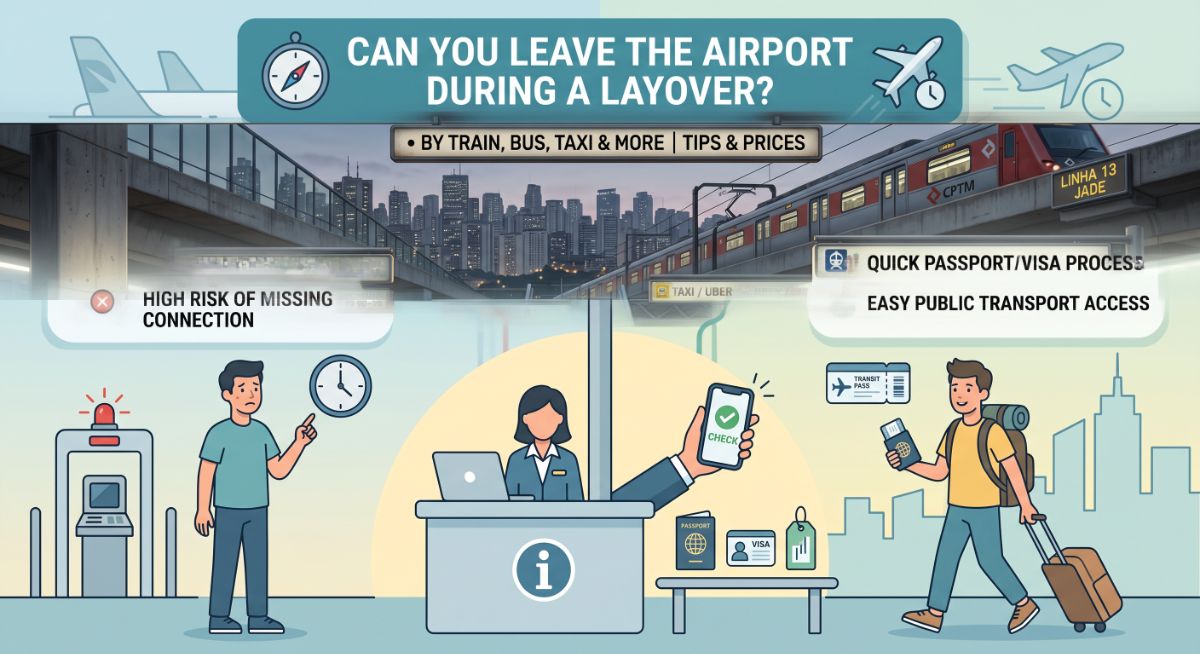
Can You Leave the Airport During a Layover?
Staring out the departure concourse windows at an eight-hour countdown on the flight monitors is one of the most draining experiences in international travel. Just beyond the security perimeter lies a world-class metropolis—its historic squares, renowned culinary hubs, and iconic landmarks merely miles away. Naturally, the pressing question on every long-haul traveler’s mind is immediate: “Am I legally allowed to step out of the airport, explore the city, and come back for my connecting flight?”
The short answer is yes: airlines and aviation security authorities do not hold passengers hostage in transit zones. However, having the legal right to exit does not automatically make it a smart decision. Leaving the terminal requires balancing immigration requirements, visa rules, checked luggage handling, transit speed, and airport security queues upon return. Failing to account for these operational variables can result in a missed flight and voided forward bookings. This comprehensive 2026 guide breaks down the real-time calculation formula, entry formalities, baggage logistics, and street-smart criteria to help you determine whether leaving the airport is worth it.
The Layover Math: Calculating True Sightseeing Time
Understand how an 8-hour international layover is consumed by mandatory airport checkpoints:
| Mandatory Operational Checkpoint | Typical Time Required | Remaining Buffer (8h Total Layover) | Crucial Traveler Protocol |
|---|---|---|---|
| 1. Deplaning, Taxiing & Border Control | 60 to 90 minutes | ~6h30 remaining | Wide-body aircraft deplane hundreds of passengers into immigration lines simultaneously. |
| 2. Inbound Transit to City Center | 45 to 60 minutes | ~5h30 remaining | Opt strictly for dedicated express rail links over highway taxis to avoid traffic jams. |
| 3. Return Security & Boarding Buffer | 120 to 180 minutes | ~2h30 to 3h00 remaining | Mandatory: screening queues, exit passport control, and gate closure (40 min prior). |
| 4. Outbound Transit Back to Runway | 45 to 60 minutes | Net Sightseeing Time: ~2 hours | Essential cushion to absorb rail delays, platform changes, or ticketing queues. |
1. Minimum Layover Windows: The Absolute Cut-Offs
To safely explore beyond terminal walls without risking your onward journey, adhere to these operational benchmarks:
- Domestic Layovers (Same Country): Minimum of 5 to 6 hours. Without passport control or customs to navigate, your departure and re-entry depend solely on passing through standard TSA or municipal aviation security screening.
- International Layovers: Minimum of 8 hours (or 10 hours at complex international mega-hubs like London Heathrow, Paris CDG, São Paulo GRU, or Tokyo Narita). International transit requires passing through incoming immigration, passport stamping, potential customs bag screening, and clearing both security and exit passport control upon return.
- The Net Time Rule: If your calculation yields less than 2 hours of net sightseeing time at your destination landmark, stay in the airport. A single unexpected subway maintenance delay or highway fender bender could cause you to miss your onward flight.
2. Immigration & Legal Entry: Do You Have Right of Entry?
The primary error travelers make on international connections is treating an airport layover as exempt from national immigration laws. The moment you cross the transit boundary toward ground exits, you are legally requesting entry into that country.
- Visas and Electronic Travel Authorizations: If your nationality requires a visa to visit the transit country for tourism, you cannot exit the terminal without one. Many destinations require pre-arranged electronic travel authorizations (such as US ESTA, Canada eTA, UK ETA, or EU ETIAS). Ensure these are valid and linked to your passport before departure.
- Transit Without Visa (TWOV) Policies: Some nations (such as China with its 72/144-hour transit exemptions, or Qatar and Singapore) provide designated visa-free transit permits at border desks for qualifying passport holders possessing confirmed onward tickets. Verify these rules at your departure check-in desk.
- Mandatory Entry Hubs: In the United States and Canada, sterile international transit does not exist. All arriving international passengers must clear full border control, collect checked baggage, and re-check bags regardless of whether they intend to leave the airport.
3. Baggage Logistics: Checked Bags vs. Carry-On Luggage
Understanding where your bags are routed determines how nimble you can be during your excursion:
- Single-Ticket Connections (Through-Checked Bags): If your journey was purchased under a single booking reference (PNR) and the baggage tags indicate your final destination code, your checked luggage stays in the custody of the airport transit system. You do not need to collect your bags; they transfer automatically to the second plane.
- Separate Tickets (Self-Transfer): If you booked two independent flights on separate airlines, you must collect your bags from the carousel, pass through customs, and haul them until check-in opens for your next flight (typically 3 hours before departure). This process severely restricts city exploration.
- Managing Cabin Bags: Never explore a foreign city dragging a 10 kg roller suitcase and an overstuffed travel backpack. Use the airport’s official Left Luggage / Luggage Storage facility (typically located in the arrivals hall or basement transit concourses) to store your carry-on bags safely for a modest hourly fee.
4. Transit Connectivity: The Rail Factor
The single factor that makes a layover excursion viable is not total hours, but the existence of a high-speed, direct rail or metro link connecting the terminal to downtown:
- Ideal Layover Hubs: Airports like Amsterdam Schiphol (14 min train to Centraal), Zurich (10 min to central station), Tokyo Haneda (13 min via monorail), and Frankfurt (12 min) feature integrated underground platforms that whisk you directly into historic city squares with predictable schedules and low fares.
- High-Risk Hubs: Airports relying strictly on congested highway corridors, shared airport vans, or metered taxi ranks (such as São Paulo GRU, Rio Galeão, Manila MNL, or New York JFK via highway traffic) present elevated risks of unexpected gridlock, making surface excursions unpredictable.
5. Returning to Your Gate: The Re-Boarding Protocol
When returning to the airport to catch your onward connection, treat the departure exactly like an initial departure from that city:
- Boarding Passes Ready: You should already have your onward boarding pass issued from your origin airport or saved digitally in your mobile airline app. If you have this pass and carry no checked luggage, bypass airline check-in desks completely and head straight to security.
- Account for Terminal Transfers: Large airports often assign connecting flights to different physical terminals. Verify on terminal monitors whether your onward flight departs from the terminal you arrived at or if you need to take an inter-terminal automated train or shuttle bus.
- Strict Gate Closure Timing: Remember that international boarding gates close strictly 15 to 20 minutes prior to published departure time, and aircraft doors close roughly 10 minutes prior. Arriving at the gate as the doors seal will leave you stranded, regardless of whether your aircraft is still attached to the jet bridge.
Essential Layover Sightseeing Street Smarts
The “Single-Objective” Strategy: Avoid creating ambitious multi-stop itineraries. Choose one primary, well-defined goal: have a meal at a landmark restaurant, walk through a specific plaza, or visit an iconic observation deck. Chasing multiple sights adds logistical tension and shrinks your safety margin for the return trip.
Set a “Hard Turnaround” Phone Alarm: As soon as you step outside the terminal doors, set a distinct, loud alarm on your phone for 4 hours before your connecting flight’s departure. The moment that alarm rings, stop what you are doing, settle bills, and immediately begin your return transit to the airport, regardless of where you are in the city.
Authoritative Border & Aviation Portals
Consult verified government and aviation resources to review entry permits, visa rules, and transit regulations before departing:
- Verify passport validity and transit visa requirements via the IATA Travel Centre Official Verification Portal.
- Check US transit and entry regulations on the U.S. Customs and Border Protection Official Travel Site.
- Review international passenger security screening protocols via the International Civil Aviation Organization (ICAO).



Post Comment