How to Get from Mexico City Airport (MEX) to the City Center: Metrobús, Metro, Uber, and Official Taxis [2026 Guide]
Stepping out of customs into the arrivals concourse at Mexico City’s Benito Juárez International Airport (MEX) drops you headfirst into the electric, fast-moving energy of a metropolis of over 20 million residents. The airport spans two distinct terminals separated by runways (Terminal 1 and Terminal 2), linked by an automated monorail (Aerotrén) and ringed by congested orbital avenues. The minute you grab your rolling bags and clear the automatic doors, the sensory rush begins: scores of private transport counters, touts soliciting unmetered rides, and standard first-timer questions: “Can I safely navigate the local subway system with heavy suitcases? Where are ride-hailing pickups like Uber legally permitted? And how do the prepaid official taxi booths work without getting scammed?”
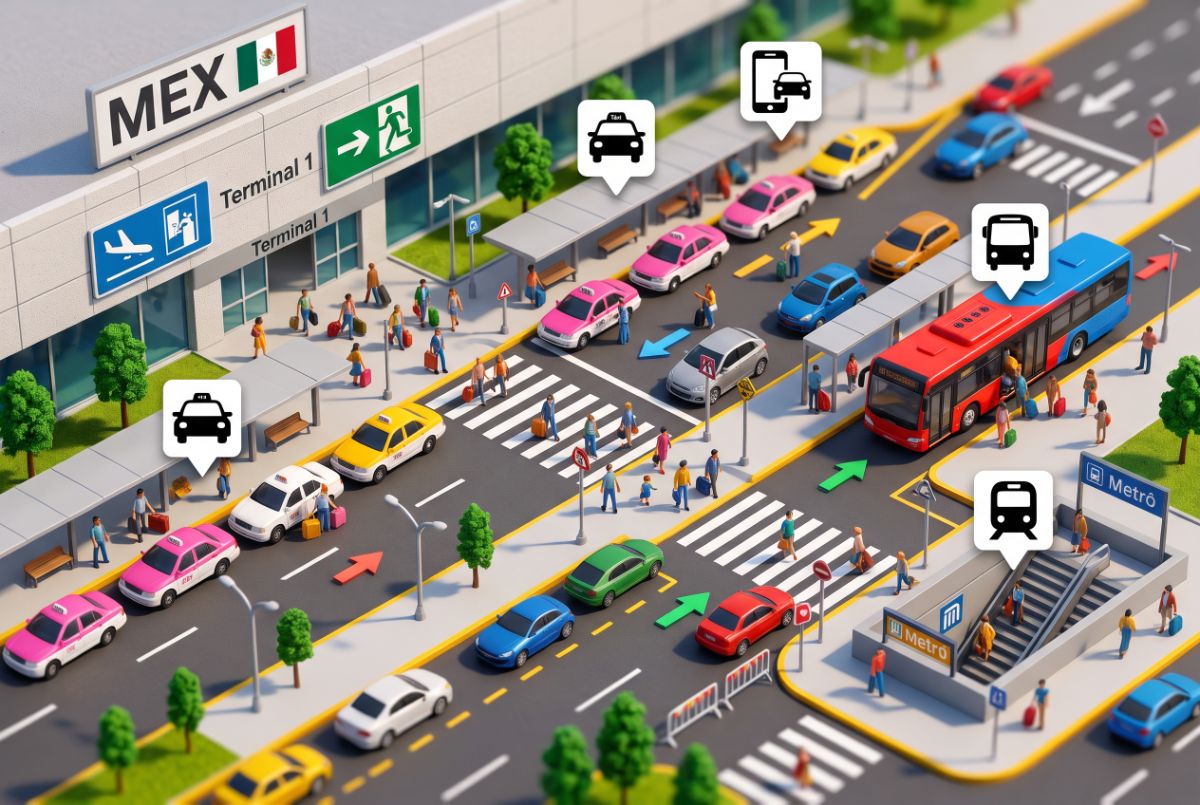
Mexico City features one of the most comprehensive and affordable public transit systems on the planet, but not every mode makes sense when lugging luggage across town. While the Metrobús Line 4 (Airport Route) offers a direct, air-conditioned bus rapid transit service with luggage racks straight into the Centro Histórico, the conventional underground Metro (Terminal Aérea station) can be overwhelming during weekday commuter hours. For travelers headed to boutique hotel districts like Roma Norte, Condesa, Paseo de la Reforma, or Polanco, prepaid authorized taxi booths and app-based rides (Uber and DiDi) remain the gold standard for curb-to-door convenience—provided you know the exact pickup doors. This comprehensive 2026 transit guide breaks down costs, transit times, and safety protocols to help you leave MEX airport smoothly.
Mexico City Airport (MEX) to Downtown: Transit Options Compared
Compare fares in Mexican Pesos (MXN) and US Dollars, transit times, luggage handling, and traveler safety across primary modes:
| Transport Mode | Average Fare (MXN / USD) | Travel Time (to Centro / Roma) | Luggage Ease | Operational Verdict |
|---|---|---|---|---|
| Metrobús (Line 4 – Dedicated BRT) | $30 MXN (~$1.70 USD) + $15 MXN card fee | 45 to 60 minutes | Good (dedicated internal luggage racks) | Best Value for Historic Center. Direct departures from both terminals; drops passengers right by Alameda Central and Bellas Artes. |
| Ride-Hailing Apps (Uber / DiDi) | $200 to $380 MXN (~$11 – $21 USD) | 35 to 55 mins (traffic-dependent) | Excellent (door-to-door trunk stowage) | Most Practical for Roma, Condesa & Polanco. Cashless, GPS-tracked, and budget-friendly; requires walking to designated curbside pickup doors. |
| Authorized Airport Taxis (Prepaid Booths) | $300 to $450 MXN (~$16 – $25 USD) | 30 to 50 minutes | Excellent | Safest for Late-Night Arrivals. Flat municipal rates purchased at indoor kiosks before stepping onto the pavement; zero surge pricing. |
| Subway Metro (Line 5 – Terminal Aérea) | $5 MXN (~$0.28 USD) | 40 to 50 mins (requires line transfers) | Worst / Challenging with roller bags | Daypack Backpackers Only. Station is outside T1, lacks escalators/elevators, crowded cars, and pickpocket hotspots. |
| Unlicensed Curbside Taxis (“Pirata” Cabs) | Arbitrary overcharging or extortion | Unpredictable | Unsafe | Strictly Avoid. Classic risk of destination detour scams, unmetered fares, and luggage ransom tricks on the curb. |
1. Terminal Layout: Terminal 1 vs. Terminal 2
Understanding which terminal you land in and how to shuttle between them prevents costly confusion:
- Terminal 1 (T1): The sprawling original terminal handling major international carriers like United, American, Air France, KLM, Iberia, Lufthansa, alongside domestic budget carriers like Volaris and VivaAerobus.
- Terminal 2 (T2): The modern facility dedicated primarily to Aeroméxico and its SkyTeam partners (such as Delta Air Lines).
- Moving Between Terminals (Aerotrén vs. Public Shuttle Bus):
- The Aerotrén Monorail: Connects T1 and T2 in roughly 5 minutes. Crucial restriction: Boarding is reserved exclusively for passengers holding a valid digital or paper boarding pass for a connecting flight. Accessible at Bridge 6 (Puente 6) in T1 and Hall M (Sala M) in T2.
- Public Inter-Terminal Shuttle Bus (Autobús T1-T2): If you do not hold an onward boarding pass, take the marked ground shuttle bus departing from Gate 7 (Puerta 7) at T1 or Gate 4 (Puerta 4) at T2. Fares run approximately $19 MXN per passenger.
2. Metrobús Line 4: The Best Public Transit Option for Downtown
The city’s Metrobús network uses dedicated, bi-articulated red buses operating in exclusive segregated lanes, largely insulated from standard traffic bottlenecks. Line 4 (Ruta Aeropuerto) is engineered specifically for airport travelers:
- Boarding Locations at MEX:
- Terminal 1: The shelter sits curbside directly outside Gate 7 (Puerta 7) on the ground level.
- Terminal 2: The stop is positioned right outside Gate 2 (Puerta 2).
- Baggage Accommodations: Unlike standard subway cars, Metrobús Line 4 vehicles feature low-floor boarding, air conditioning, CCTV monitoring, and dedicated interior metal luggage shelving to keep roller bags secure while seated.
- Tickets & Smart Card Payment:
- Airport route tickets cost $30 MXN per passenger (roughly $1.70 USD).
- Boarding requires the rechargeable Integrated Mobility Card (Tarjeta de Movilidad Integrada), available for $15 MXN at automated touchscreen kiosks at the airport boarding bays (accepting Mexican Peso notes and chip/contactless cards).
- A single card can be shared across multiple travelers: simply tap the card against the turnstile scanner once for each member of your group as long as the loaded cash balance covers the total fare.
- Route & Key Stops: The line runs straight toward the historic center, stopping at San Lázaro (major intercity bus depot), Bellas Artes, Hidalgo, and Buenavista, letting you step off near central Alameda and historic core hotels without complex transfers.
3. Ride-Hailing Apps (Uber & DiDi): Where to Meet Your Driver
Uber and DiDi operate extensively across Mexico City, providing transparent, cashless pricing that is typically half the cost of authorized hotel limousines:
- Airport Zone Regulations: As federal property, MEX airport experiences intermittent enforcement checks against app drivers. However, ride-hailing services operate regularly, picking up passengers from public curbside departure and arrival lanes.
- Designated Meeting Doors:
- Terminal 1: When opening the app to request a car, select ground-level arrival doors—Door 3, Door 4, or Door 5 (Puertas 3, 4, 5). Step onto the curb under the numbered overhead gate sign.
- Terminal 2: The smoothest, least congested pickup zone is curbside outside Door 3 or Door 4 (Puertas 3, 4).
- Average Rates & Times: A ride to Roma Norte, Condesa, or Paseo de la Reforma typically costs between $200 and $350 MXN ($11 to $19 USD) outside peak surge windows. To the historic downtown core (Centro), rates usually average $160 to $240 MXN.
- Airport Wi-Fi: If you do not yet have a local Mexican eSIM or cellular data plan, connect to the free municipal Wi-Fi network (“Gratis CDMX – C5”) available across both terminal lobbies to order your ride.
4. Official Authorized Taxis: The Prepaid Kiosk Method
If you touch down after midnight, carry dead phone batteries, or prefer an established private transfer without navigating apps:
- Zonal Prepaid Pricing: Official airport taxis do not run meters from MEX. The greater capital is divided into predetermined geographic distance concentric zones. You pay a fixed municipal rate calculated by the neighborhood of your destination.
- Buy Exclusively from Indoor Kiosks: Inside the baggage reclaim and arrivals concourses—before exiting to the exterior street—you will pass licensed official taxi company counters, including Sitio 300, Nueva Imagen, Porto Taxi, Confort, and Casade.
- Approach an authorized booth and provide your hotel’s street address and neighborhood (colonia).
- Pay the fixed fare via credit card or cash (typically $300 to $450 MXN for central tourist corridors).
- The agent hands you a printed two-part voucher receipt (boleto de taxi).
- Walk through the sliding doors to the designated taxi bay on the curb and hand your voucher to the uniformed company dispatcher, who escorts you to your licensed cab.
- Beware Curbside Tout Scams: Completely ignore any individuals standing in the terminal lobby whispering “Taxi, amigo? Private car to Roma?”. These are unlicensed drivers who routinely demand triple the going rate or demand extra cash per bag upon delivery.
5. Subway Metro (Line 5): Why You Should Avoid It with Luggage
Mexico City’s subterranean Metro is famous for its dirt-cheap $5 MXN ($0.28 USD) flat fare. However, boarding it with vacation luggage right after a flight is usually a major mistake:
- Inconvenient Access: The station serving the airport is Terminal Aérea (Line 5 – Yellow), located outside Terminal 1, requiring a 300-meter walk along exposed outdoor pavements. If you land at Terminal 2, there is no direct pedestrian access to the Metro without taking a shuttle bus or monorail first.
- Severe Luggage Constraints: Subway cars on Line 5 and central transfer lines (such as Line 1 and Line 3) are frequently packed to capacity. Turnstiles are narrow full-height iron cages, escalators and elevators are frequently out of order or absent, and transfer tunnels between connecting lines often involve walking 500 meters up and down steep staircases.
- Pickpocket Exposure: Attempting to balance two large rolling suitcases while crammed into packed train doorways during morning or evening rush hours makes you an easy mark for organized pickpocket teams. Save the Metro for light day trips when carrying only a secure crossbody bag.
Essential Mexico City Arrival Street Smarts
Currency Exchange at MEX Airport Is Genuinely Competitive: Contrary to worldwide travel wisdom, the street-level currency exchange booths (casas de cambio) in Terminal 1 of Mexico City Airport offer some of the best USD/EUR-to-MXN conversion rates in the entire country. The heavy concentration of dozens of competing booths on the ground floor drives competitive spreads. It is worth changing $100 to $200 USD in cash right after baggage reclaim.
Factor in Weekday Gridlock: Mexico City traffic is legendary. During weekday morning rush hours (07:00 to 09:30 AM) and evening commute peaks (18:00 to 20:30 PM), a car ride to Polanco or Santa Fe can balloon from 40 minutes to over 1 hour and 30 minutes. If your hotel is located in the Centro Histórico, Metrobús Line 4 is often substantially faster than an Uber because it bypasses jams via dedicated bus-only lanes.
Authoritative Transit Portals & Airport Resources
Verify live terminal maps, Metrobús timetables, and official transit networks via authorized Mexican civil channels:
- Check terminal services, official prepaid taxi operators, and flight status on the Mexico City Benito Juárez International Airport (AICM Official Portal).
- Review Line 4 airport schedules, station stops, and route maps via Metrobús de la Ciudad de México.
- Check subway network maps and operational advisories on the Metro de la Ciudad de México (STC).
- Explore integrated transit guidelines and mobility fare structures via Secretaría de Movilidad de la Ciudad de México (SEMOVI).


Post Comment