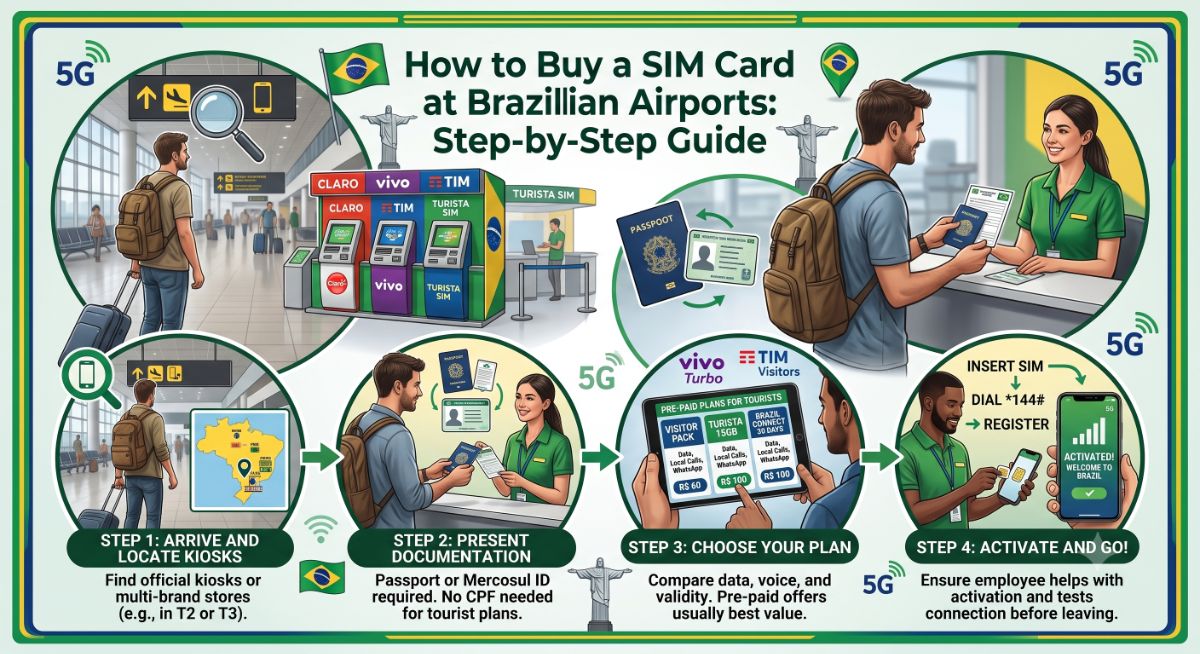
How to Buy a SIM Card at Brazilian Airports: Step-by-Step Guide
Arriving in a new country without a working internet connection is one of the most stressful experiences a modern traveler can face. As soon as you step off the plane in Brazil—whether at São Paulo’s Guarulhos (GRU) or Rio de Janeiro’s Galeão (GIG)—you immediately need connectivity to order a safe rideshare, access your hotel reservation, translate Portuguese signs, or let your family know you landed safely. Relying on slow, spotty, and unsecured public airport Wi-Fi is rarely a reliable solution.
The process of getting connected in Brazil can be notoriously confusing for foreigners. Due to strict local regulations, buying and activating a prepaid mobile line typically requires a Brazilian CPF (taxpayer registry number), which most tourists do not have. This often leads to frustrating delays, language barriers at the counter, or tourists overpaying for inadequate international roaming plans. Fortunately, major Brazilian airports have adapted to make this process easier. This step-by-step guide will show you exactly how to secure a local SIM card quickly and legally in 2026.
Connectivity Options at Brazilian Airports
Compare the main ways to get mobile internet immediately after landing in Brazil:
| Option | Avg. Cost (BRL/USD) | Activation Time | Pros & Cons |
|---|---|---|---|
| Prepaid eSIM (Digital) | R$ 40 – R$ 150 / $8 – $30 USD | Instant (1-5 mins) | Pro: Active before landing, no physical stores. Con: Requires eSIM-compatible phone. |
| Airport Carrier Store (Physical SIM) | R$ 80 – R$ 150 (Tourist Plans) | 15 – 30 mins | Pro: Staff handles the registration for you. Con: Lines can be long; higher tourist pricing. |
| Airport Convenience Store (7-Eleven/Local) | R$ 15 – R$ 30 (Chip only + top-up) | Delayed (Can take hours) | Pro: Cheapest raw hardware cost. Con: You must self-register (nearly impossible without a CPF). |
Step-by-Step: How to Buy and Activate Your SIM Card
Step 1: Locate the Right Shop in the Arrivals Hall
Once you collect your luggage and exit the secure customs area into the public arrival terminal, look for the official retail spaces.
- Major Carriers: The three dominant mobile networks in Brazil are Vivo, Claro, and TIM. All of them have a highly reliable 5G presence across major cities.
- Official Stands vs. Resellers: Look for the actual branded stores or authorized kiosks (like “Turismo Câmbio” or electronic shops) rather than general newsstands. The specialized kiosks are specifically set up to handle foreign passport registrations.
Step 2: Present Your Documents (The Passport Hack)
By Brazilian law, all mobile lines must be registered to an individual’s identity to prevent fraud. For locals, this is done using their CPF number.
- Use your Passport: As an international tourist, you are legally allowed to register a prepaid SIM card using only your physical passport.
- The Trap: If you buy a cheap SIM card from a general newsstand or convenience store, the automated activation menu on your phone will require a CPF to proceed. It is highly recommended to purchase your SIM at an official airport carrier stand where the attendant can bypass the CPF requirement using their internal system with your passport.
Step 3: Choose a “Tourist” or “Prepaid” Plan
Most airport stands offer specialized “Tourist SIM” packages. While they are slightly more expensive than the standard packages sold to locals in the city center, they are highly convenient.
- What is included: These plans usually range from 10GB to 50GB of high-speed data, valid for 15 to 30 days, often including unlimited WhatsApp use (which does not consume your data package).
- Payment: Airport kiosks accept major international credit cards (Visa/Mastercard) and mobile payments. Ensure your card is unlocked for international transactions in Brazil.
Survival Tips: Getting Connected Without Hassle
The eSIM Advantage: If your mobile phone supports eSIM technology, the most practical hack in 2026 is to buy a global or regional Brazil eSIM online before you even board your flight. You can install it at home, and the moment your plane lands in Brazil, you will immediately connect to a local network (usually TIM or Vivo) without needing to find a physical store, swap chips, or deal with passport registrations.
Check Your Phone’s Compatibility: Brazil operates its 4G and 5G networks on specific frequency bands (primarily bands 1, 3, 7, 28, and the 3.5 GHz band for 5G). Most modern, unlocked smartphones from the US, Europe, and Asia will work flawlessly, but it is always smart to double-check that your device is carrier-unlocked before traveling.
Official Telecommunication & Airport Portals
For official travel regulations and carrier coverage maps, consult the authorized resources:
- Review foreign traveler guidelines and telecommunication rights on the Anatel (National Telecommunications Agency) Official Portal.
- Find terminal maps, store locations, and services at Brazil’s primary gateway on the GRU Airport Official Website.
Post Comment